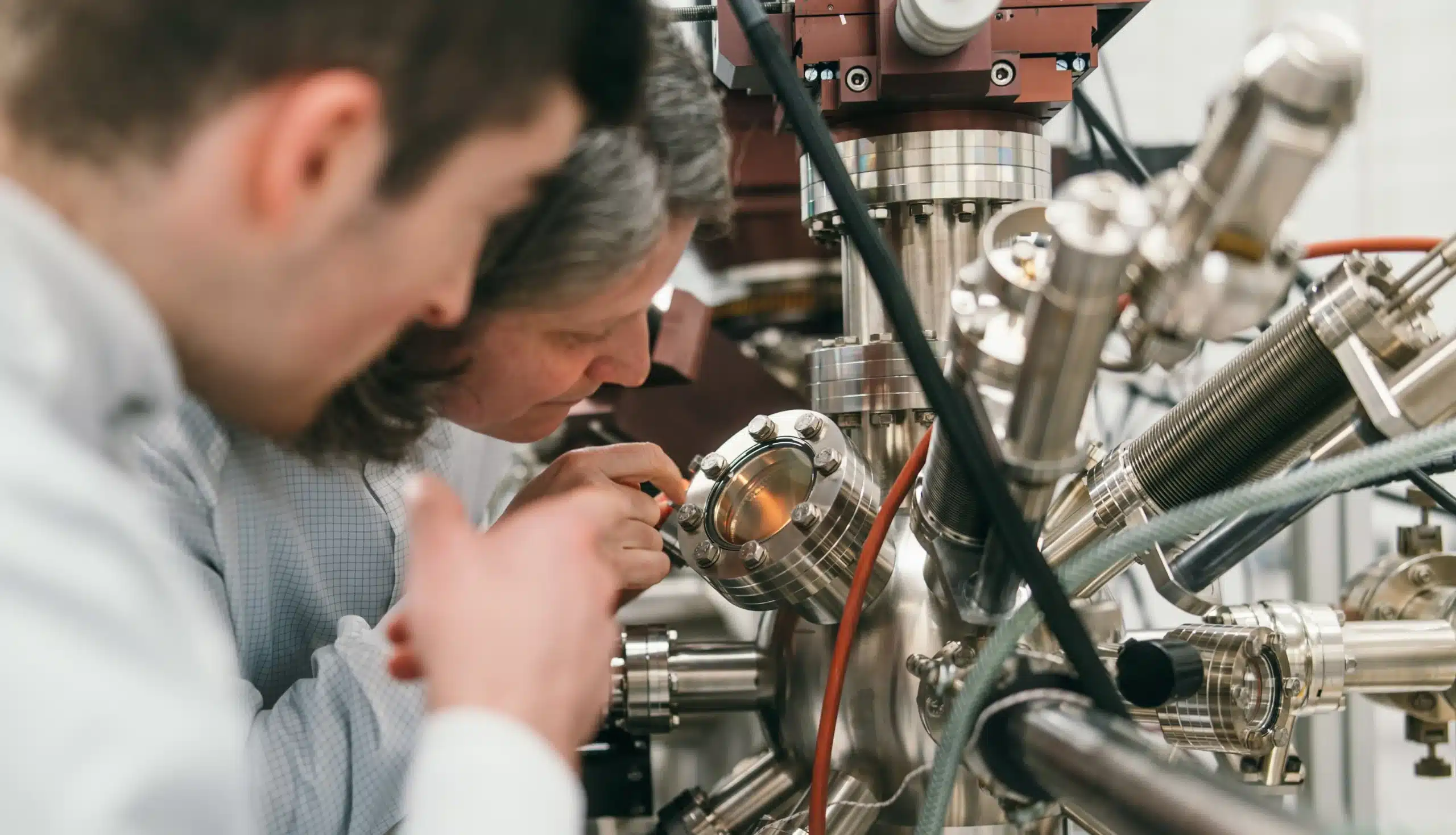
Chirality describes a fundamental symmetry property – an object cannot be superimposed on ist mirror image – leading to structural stability and directionality in nature. The team of the Cluster of Excellence „Center for Chiral Electronics“ (CCE) will investigate chirality at the molecular, atomic and electronic level and thus, explore how this principle can be harnessed for new mechanisms for spin and charge transport, enabling the design of low-dissipation, high-performance electronic devices.
Our research focuses on three interrelated areas: the synthesis and manipulation of structural chiral materials (area A), the emergence of chiral properties due to symmetry breaking (area B), and ultrafast control and switching of chiral states using intense light fields (area C). By integrating experimental and theoretical approaches across physics, chemistry, and materials science, we aim to develop a comprehensive understanding of chirality in condensed matter, fostering next-generation device concepts that operate robustly over wide temperature and timescales.
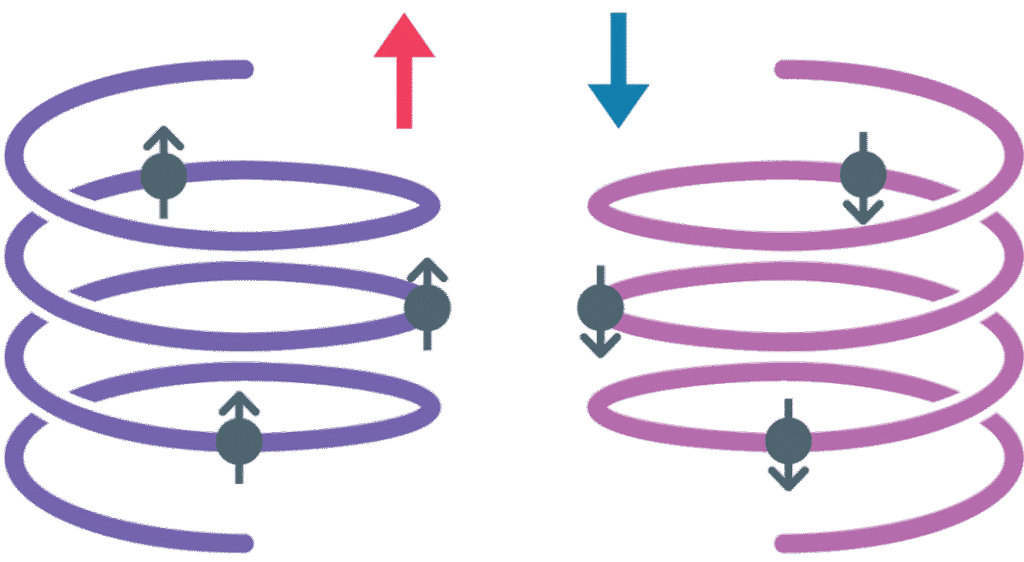
In research area A, we investigate electronic and transport properties in a wide range of chiral material classes to understand how the electron spin interacts with the chiral electronic degrees of freedom. This includes studying the role of spin-orbit coupling and orbital currents in various systems, e.g., chiral organic molecules and polymers, twisted chiral stacks of 2D materials, and in chiral Weyl semimetals.
We aim to provide a unifying microscopic theory that explains the long-standing phenomenon of the chirality-induced spin selectivity (CISS) being first observed at chiral molecular interfaces. Extending CISS research to other material classes could reveal new platforms for generating spin-polarized currents at higher densities than those achieved in organic systems. These currents have the potential to be utilized for spin switching at the interface to a magnetic materials with possible applications for memory and logic devices. By elucidating the mechanisms behind chiral spin transport, we aim to contribute to the development of highly efficient, spin-based electronic functionalities with broad technological relevance.
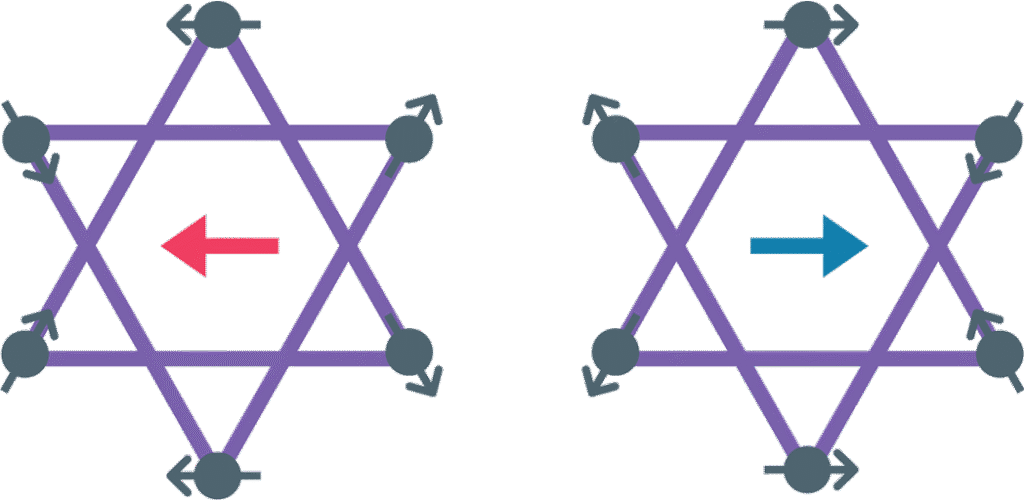
In research area B, we investigate complex spin textures in real space, such as chiral antiferromagnets and skyrmions, which feature discrete and resilient spin configurations. These structures allow for a magnetoelectric response from systems without a net magnetic moment, thereby enabling a highly efficient chiral spintronics. An additional approach involves studying spin-polarized supercurrents carried by spin-triplet Cooper pairs, aiming to harness their potential for low-dissipation switching.
We will analyze spin torques generated by injection of triplet supercurrents and explore their applications in low-dissipation devices. Furthermore, magneto-chiral supercurrents will be used to implement novel devices. By engineering chiral superconducting structures with atomic-scale precision, we seek to understand the interplay between chirality and superconductivity, identify edge states, and unvover chirality-specific transport properties. We aim to foster new functionalities in low-loss spintronic and superconducting devices, advancing the fundamental understanding of chiral quantum matter and enabling innovative technological applications.
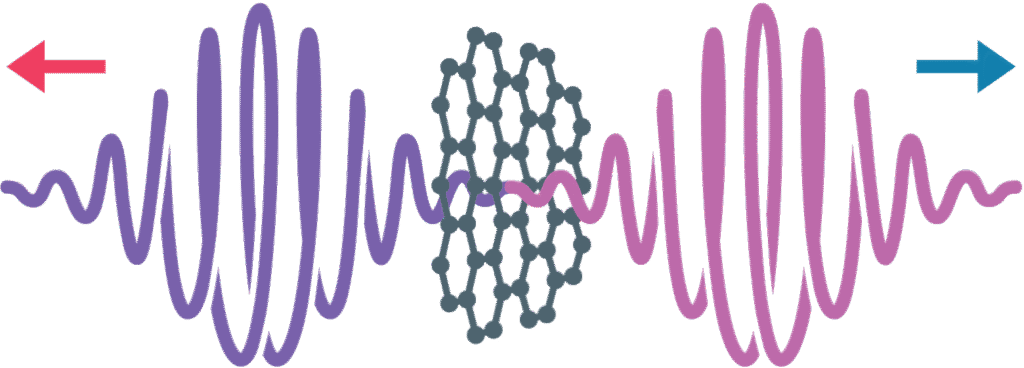
In research area C, we focus on chiral light-matter interaction where either the ultrashort, intense light pulse or the samples themselves exhibits chiral properties. Our primary focus is on non-equilibrium carrier dynamics in photo-excited chiral semimetals. Here, we aim to understand the relevant relaxation channels and explore how complex spin texture and Berry-phase monopoles in reciprocal space influene spin-charge conversion processes.
Building on this insights, we will use the electric field of light to coherently accelerate carriers through the complex band structure of chiral semimetals, thereby paving the way to novel chiral lightwave electronics operating at optical clock rates – a thousand to a million times faster than current electronics. Furthermore, we will exploit coherent light-matter interactions to design chiral materials out of equilibrium. This includes coherently driving carriers around Berry-phase monopoles in momentum space or resonantly exciting large-amplitude chiral atomic motions to modify and tailor the band structure of the material, inducing new electronic properties. These approaches aim to establish a foundation for ultrafast, light-driven electronic devices and deepen our understanding of chiral quantum materials.
We bring together leading scientists from physics, chemistry and material science across Halle (Saale), Berlin and Regensburg. We foster an international network of researchers, combining expertise in experimental and theoretical approaches to explore the fundamental and applied properties of chirality in solid-state and molecular systems.
Findable – Accessible – Interoperable – Reusable
We are committed to manage our research data in accordance with the FAIR principles to ensure transparency, reproducibility, and long-term usability. Our dedicated data scientists will develop an open and sustainable research data infrastructure. All research data will be published in standardized formats within open repositories, These efforts strengthen research quality and facilitate the worldwide reuse and impact of our data, fostering scientific exchange and visibility.